
Pennsylvania Court Records Online Access
Pennsylvania court records are public documents you can search through the state's Unified Judicial System. The UJS Portal gives free access to docket sheets from all court levels, including the Courts of Common Pleas, Magisterial District Courts, and appellate courts. You can look up cases by name, docket number, or citation number. This guide explains how the system works, what records are available, and how to get copies of court documents from Pennsylvania courts across all 67 counties.
Pennsylvania Court Records Quick Facts
Pennsylvania Court System Overview
The Pennsylvania Unified Judicial System is the framework that connects all courts across the state under one administrative structure. It includes five distinct court levels, each handling different types of cases. The Supreme Court sits at the top. Below it are two intermediate appellate courts: the Superior Court and the Commonwealth Court. The Courts of Common Pleas serve as the main trial courts. Magisterial District Courts handle minor matters and are the entry point for most residents who interact with the legal system.
This image shows the main gateway to all Pennsylvania court resources, including public docket access and court rules.
Pennsylvania organizes its Courts of Common Pleas into 60 judicial districts across the 67 counties. Some smaller counties share a judicial district. Each district maintains its own local rules that supplement the statewide rules of procedure. Court records from these courts are accessible through the UJS Portal at no charge. The portal provides docket sheets that summarize all court actions taken in a case. These records cover the name of the court, the presiding judge, documents filed, scheduled hearings, and case outcomes. Under 204 Pa. Code § 213.81, the Electronic Case Record Public Access Policy governs what information appears online and what must be redacted.
Pennsylvania courts handle millions of filings each year. The volume reflects the state's large population and active legal system. Whether you are looking for a civil judgment, a criminal case, or a traffic citation, the UJS provides a central starting point for all Pennsylvania court records searches.
How to Search Pennsylvania Court Records
The UJS Case Search tool at ujsportal.pacourts.us/CaseSearch is the primary way to look up Pennsylvania court records online. No account or registration is needed. The search is free to anyone with internet access. You can search across all court levels from one screen.
The portal offers several search methods. You can search by participant name using a first and last name, with an optional date of birth to narrow results. You can also search by docket number if you already know the case identifier. Other options include citation number, incident number, and Offense Tracking Number (OTN). The OTN is useful because it links records across court levels for the same defendant in the same case. You can also search by organization name for business-related cases. Leaving the county field blank runs a statewide search across all 67 Pennsylvania counties at once.
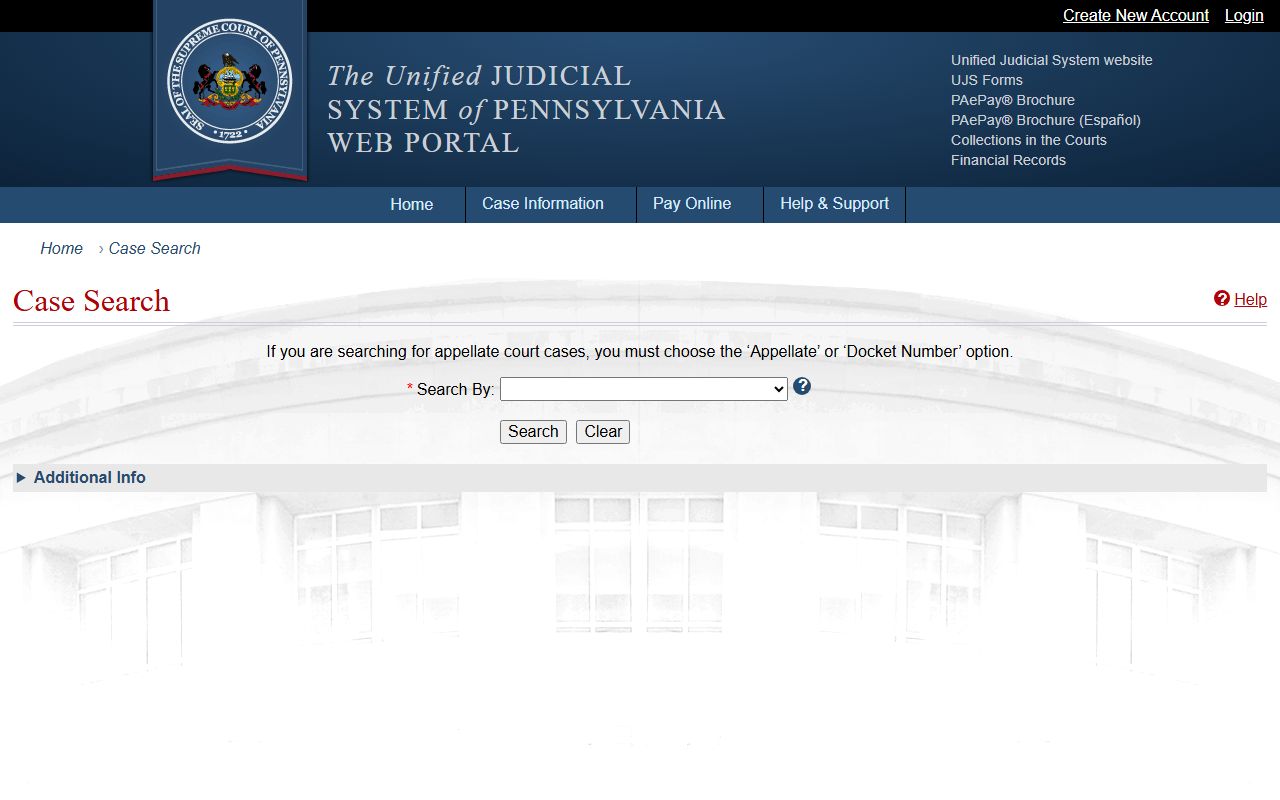
The UJS Portal case search screen shown above allows name, docket, OTN, and citation searches across all Pennsylvania court levels.
Search results show docket sheets for matching cases. A docket sheet is a chronological record of every action taken in a case. It lists the court name, the judge assigned, documents filed, hearing dates, and the current status. For criminal cases at the Common Pleas and Philadelphia Municipal Court levels, the portal also shows Court Summary reports that include case disposition, fines, costs, and payment status. Keep in mind that recent filings may not appear right away. There can be a delay between when something is filed at the courthouse and when it shows up on the portal. Also note that the actual documents filed in a case are not available online. Only the docket entry exists. To get copies of filings, you must contact the county Clerk or Prothonotary directly. The free PAeDocket mobile app, available on both the App Store and Google Play, lets you run the same searches from a phone or tablet.
Note: Docket sheet information from the UJS Portal is not the same as an official criminal history report and should not be treated as one.
Pennsylvania Court Levels and Record Types
Each court level in Pennsylvania generates different types of records. Knowing which court handled a case helps you find the right records quickly. The five court levels cover a wide range of legal matters, from traffic tickets to constitutional disputes.
The Pennsylvania Supreme Court is the court of last resort. Seven justices serve ten-year elected terms. The court decides appeals of great public importance and has administrative authority over all courts in the state. Supreme Court records include opinions, orders, and case dockets available through the UJS Portal.
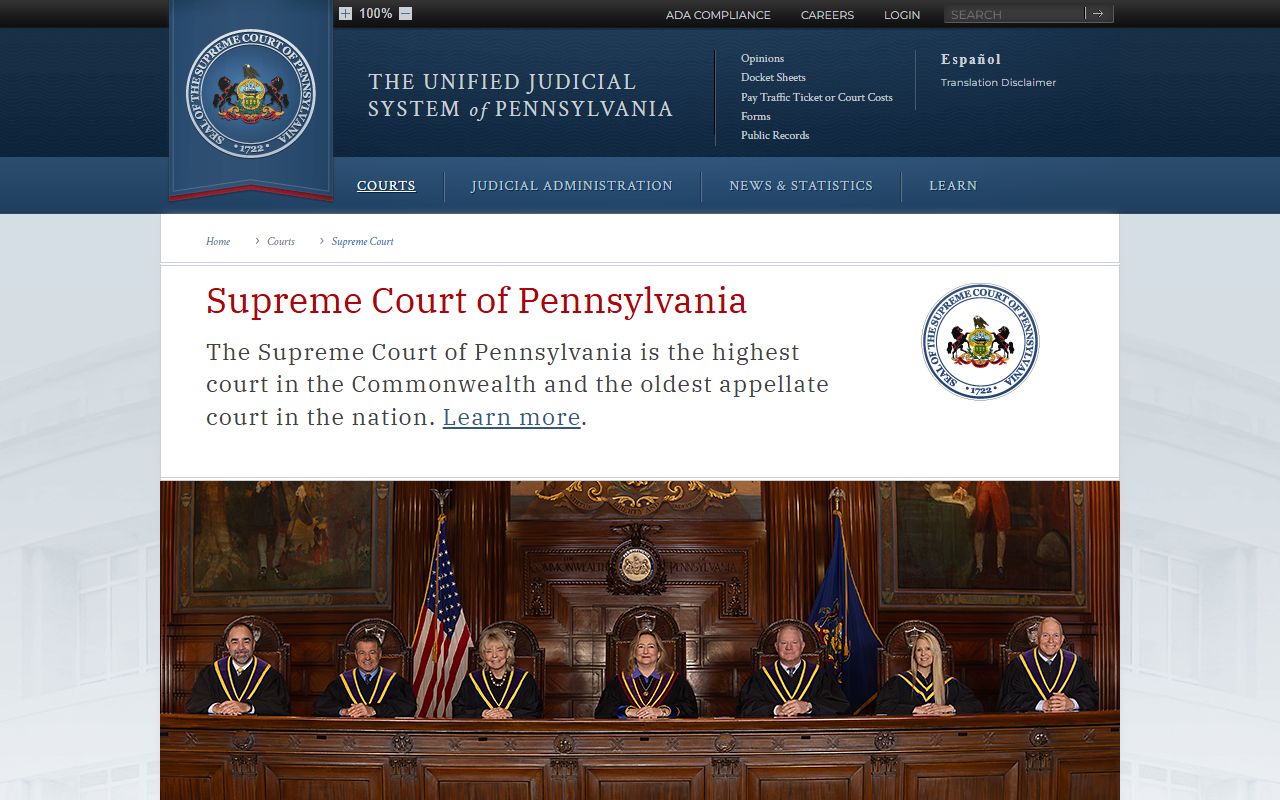
The Pennsylvania Supreme Court page above provides access to opinions, orders, and docket information for the state's highest court.
The Pennsylvania Superior Court is an intermediate appellate court. It reviews criminal and civil appeals from the Courts of Common Pleas. District filing offices are in Philadelphia, Harrisburg, and Pittsburgh. Superior Court dockets are searchable through the UJS Portal. Valid identification is required to view records in person at Superior Court filing offices.
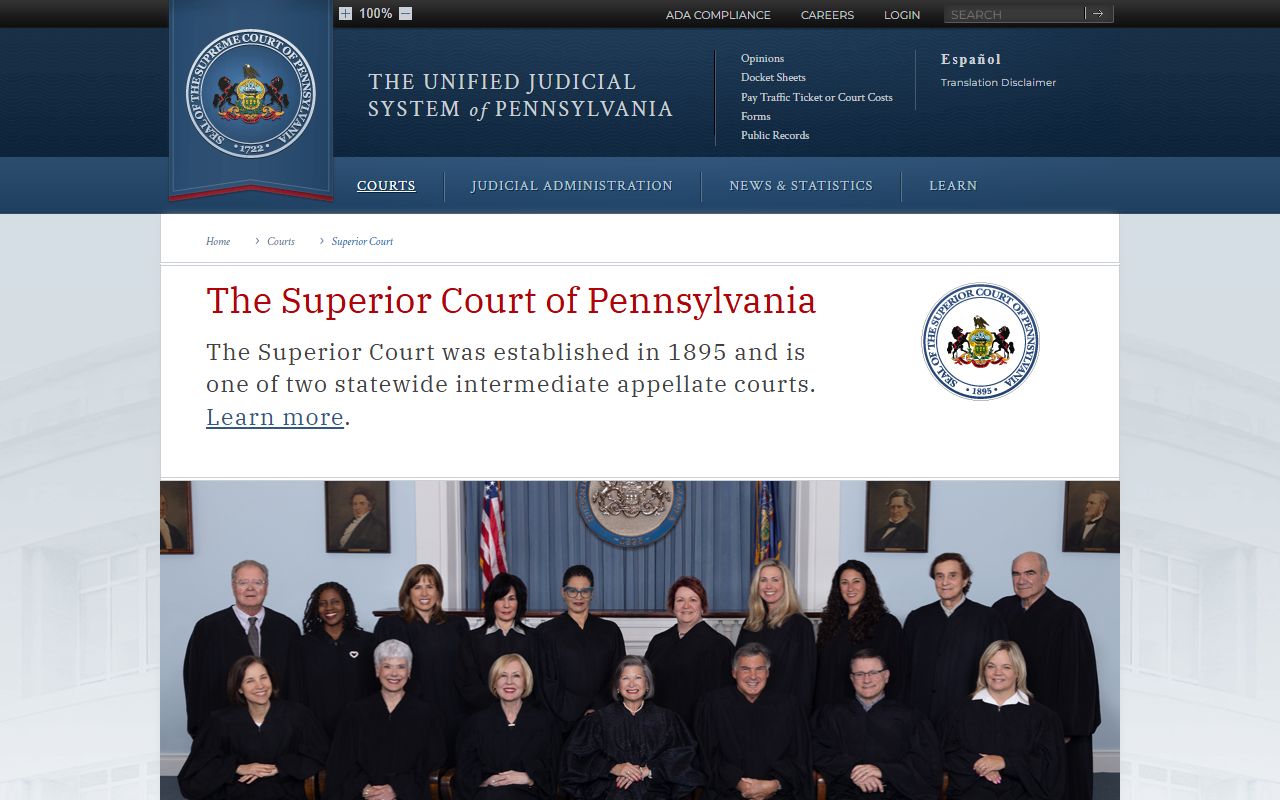
The Superior Court page above covers how to access Pennsylvania court records filed with the intermediate appellate court, including in-person and electronic options.
The Pennsylvania Commonwealth Court handles appeals from state agencies and civil cases involving the government. It hears challenges to decisions by bodies like the Unemployment Compensation Board and the Workers' Compensation Appeal Board. Livestream arguments are available for public viewing. Commonwealth Court records are part of the broader Pennsylvania court records system accessible through the UJS Portal.
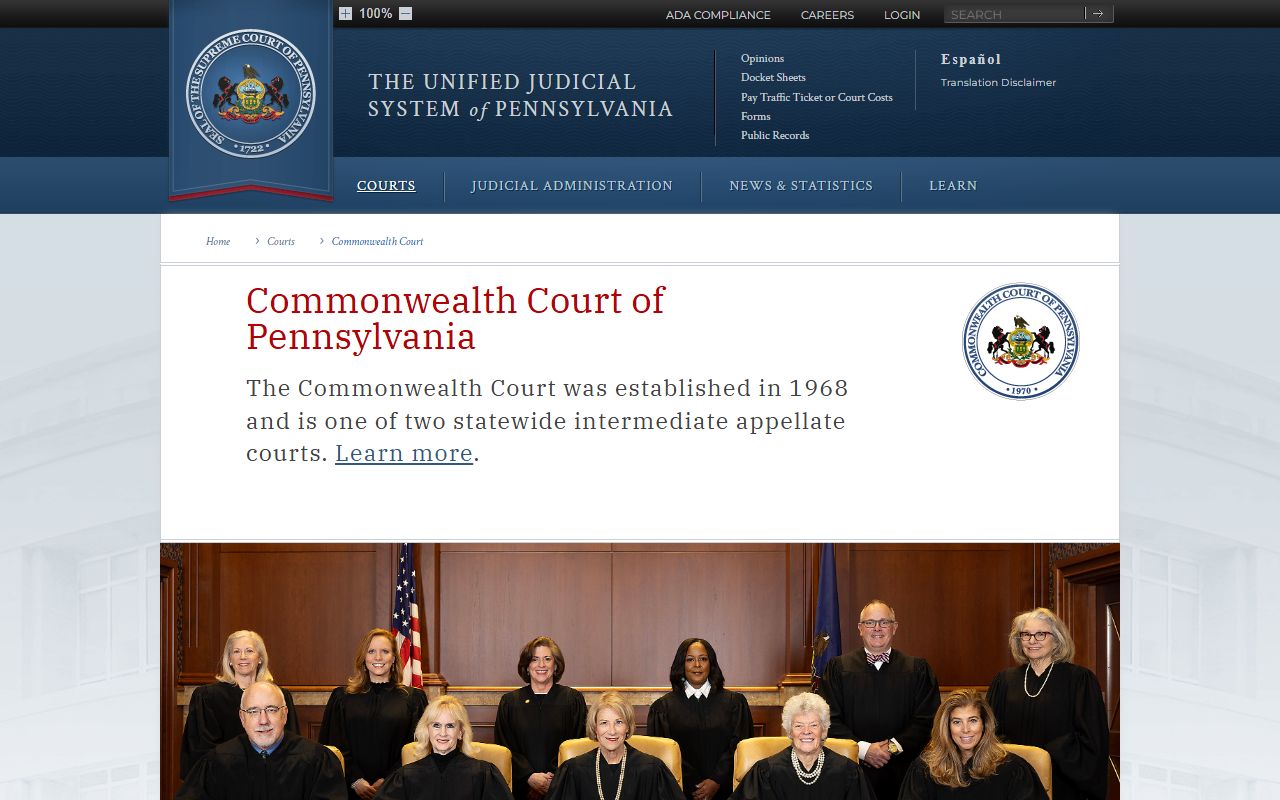
The Commonwealth Court page above covers Pennsylvania court records for government-related appeals and agency decisions.
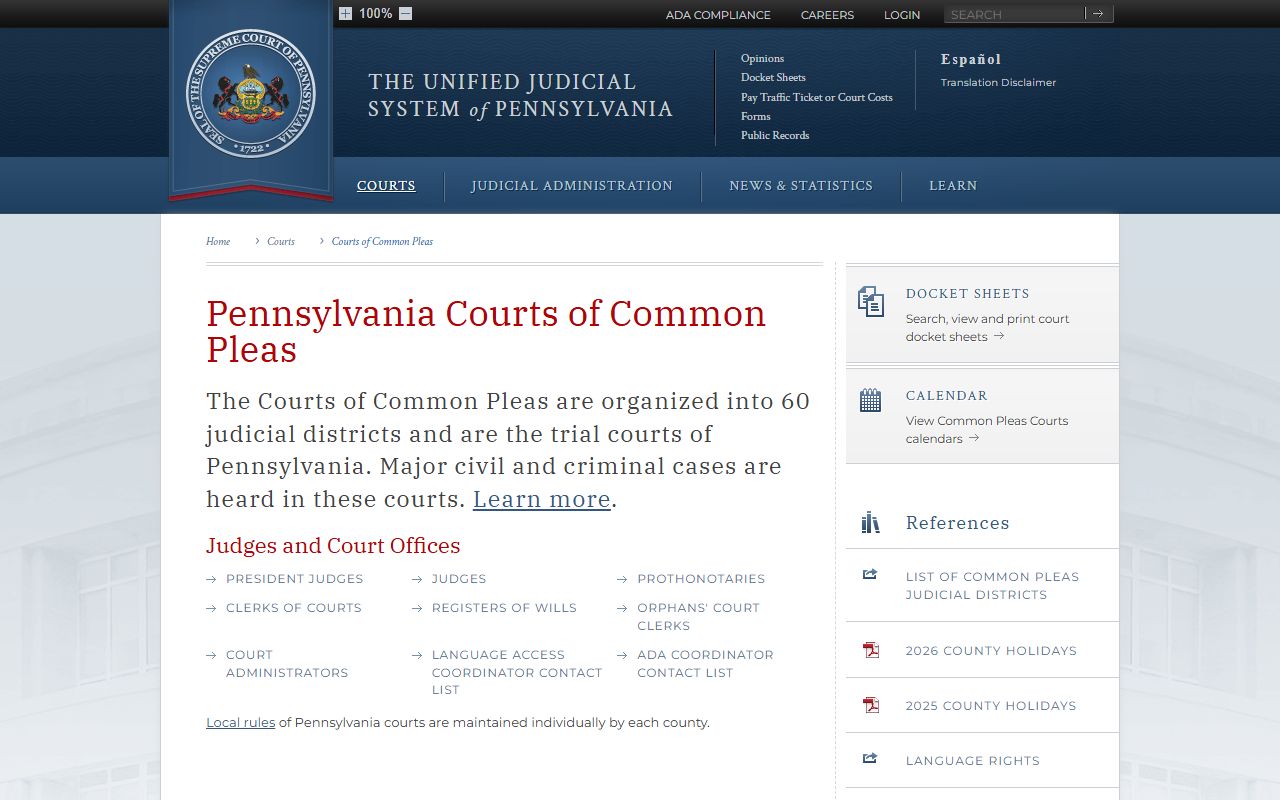
The Courts of Common Pleas page above shows how each county's trial court connects to the broader Pennsylvania court records system.
The Courts of Common Pleas are the main trial courts. They cover all 67 counties through 60 judicial districts. These courts hear serious criminal cases, civil disputes, family matters, and appeals from lower courts. Each court has divisions including Criminal, Civil, Family, and Orphans' Court.
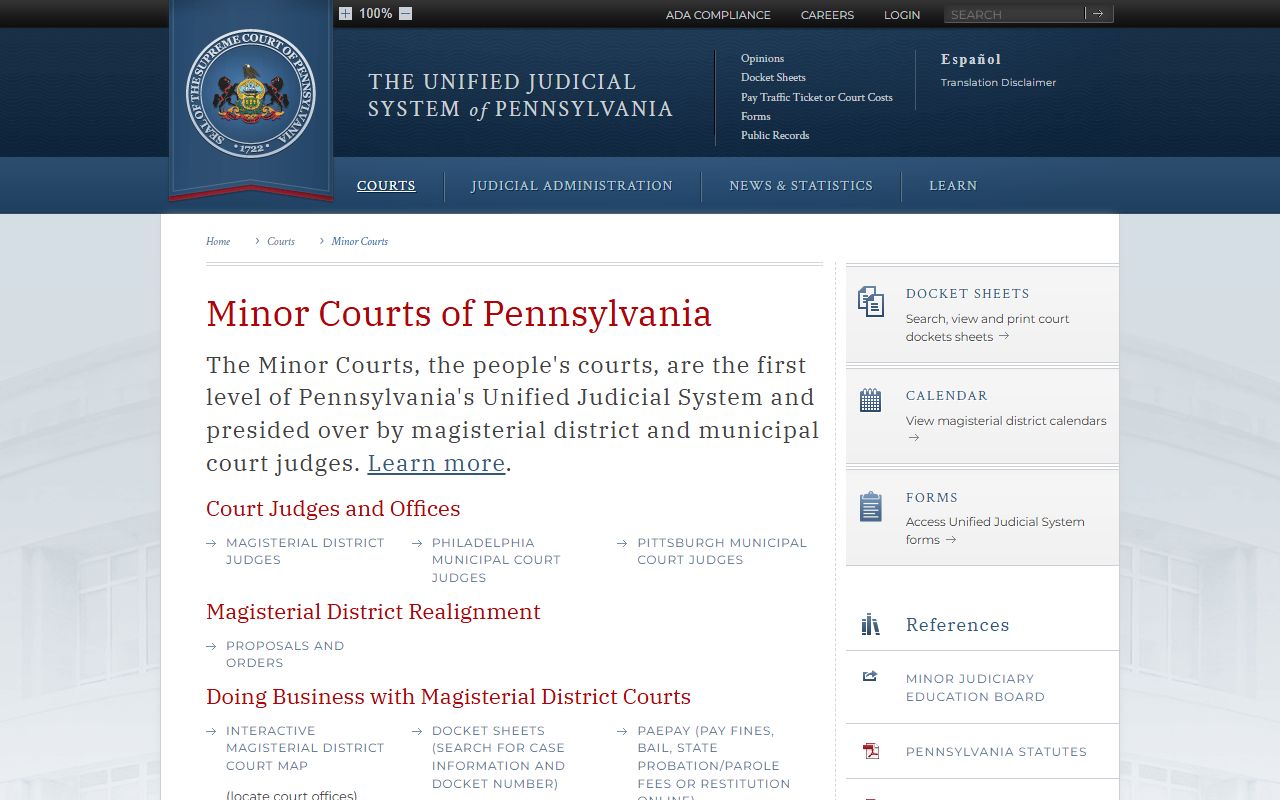
The Minor Courts page above covers Magisterial District Judge courts, which handle the highest volume of cases in Pennsylvania's court records system.
The Magisterial District Courts are the entry-level courts. Magisterial District Judges are elected to six-year terms. These courts process preliminary hearings, traffic citations, summary offenses, and civil claims under $12,000. Philadelphia and Pittsburgh have specialized Municipal Courts. All MDJ Pennsylvania court records are searchable through the UJS Portal by docket number or participant name.
Criminal Court Records in Pennsylvania
Criminal court records in Pennsylvania follow a case from the first hearing through final disposition. Most criminal matters begin at the Magisterial District Court level. A preliminary hearing takes place before an MDJ to decide whether enough evidence exists to send the case to the Court of Common Pleas. If the case moves forward, the Common Pleas court handles arraignment, pre-trial motions, trial, and sentencing. Records from both courts appear on the UJS Portal.
You can search criminal Pennsylvania court records using several identifiers. The participant name search works well when you know the defendant's full name and date of birth. The OTN search links all records connected to a single offense across court levels. Docket sheets for criminal cases show charges filed, pleas entered, motions, hearings, and the final outcome including any sentence. The Pennsylvania Rules of Criminal Procedure at Title 234 govern how criminal cases proceed. Court records generated under these rules are public except where sealed by court order or automatically restricted by statute.
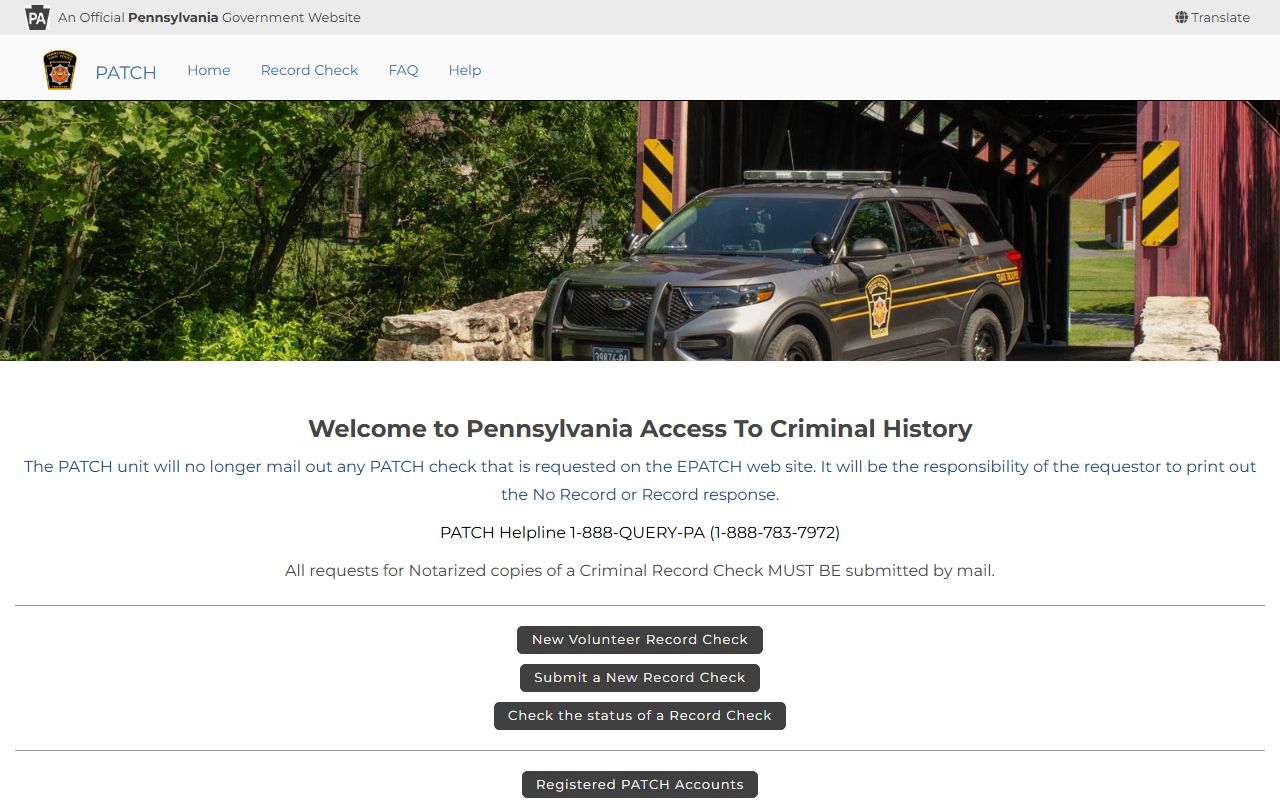
The PATCH system shown above is the official Pennsylvania state source for certified criminal history records, separate from the free court docket search.
For an official criminal history report, the Pennsylvania Access to Criminal History (PATCH) system is the right tool. PATCH is maintained by the Pennsylvania State Police under the Criminal History Record Information Act, 18 Pa.C.S. § 9101. The fee is $22 per request. Results show conviction history as maintained by the state. About 85% of searches return a "No Record" response immediately. More complex searches may take up to two weeks. PATCH does not replace a docket sheet search; the two systems serve different purposes. Court dockets show everything filed in a case. PATCH shows official conviction records from the repository maintained by state police. You can call the PATCH helpline at 1-888-QUERY-PA for help with your request.
Note: Cases may not appear in the UJS Portal if they were sealed, expunged, or entered under a misspelled name.
Civil Court Records in Pennsylvania
Civil court records in Pennsylvania cover a broad range of disputes. Lawsuits between individuals, businesses, landlords and tenants, and claims for money damages all generate records at the court. The Prothonotary in each county is the clerk for civil matters at the Court of Common Pleas. Civil case records are public under Pennsylvania Rules of Civil Procedure, Title 231.
A civil case file at the Court of Common Pleas includes the initial complaint, any answer filed by the defendant, motions, orders, and the final judgment. These documents are filed with the Prothonotary and kept in the case file. The UJS Portal lets you search civil Pennsylvania court records by party name or docket number and view docket entries. To get copies of the actual filings, you must contact the Prothonotary's office in the county where the case was filed. Each county sets its own copy fees. Most charge per page for plain copies and more for certified copies.
Small civil claims under $12,000 are handled by Magisterial District Courts. These courts process landlord-tenant disputes, security deposit cases, and minor money claims. MDJ civil records are also searchable through the UJS Portal. Judgments entered by an MDJ can be appealed to the Court of Common Pleas for a full trial on the merits.
Online Access to Pennsylvania Court Records
Pennsylvania provides several online tools for accessing court records and managing court-related tasks. The UJS Portal is the broadest tool. It covers docket searches, public calendars, and case summaries. The public calendar feature lets you search for scheduled hearings at Criminal Courts of Common Pleas and Magisterial District Courts. This is useful if you want to know when a case is set for a hearing without going to the courthouse.
PACFile is the electronic filing system for appellate courts in Pennsylvania. It allows attorneys, pro se parties, and designated proxies to submit documents to the Supreme Court, Superior Court, and Commonwealth Court without mailing paper copies. After registering for an account, a filer can submit documents, pay fees by credit or debit card, and receive notices of court action through the system. Within seven days of an electronic submission, filers must also send a bound paper version to the court. PACFile is governed by the Pennsylvania Rules of Appellate Procedure, Title 210.
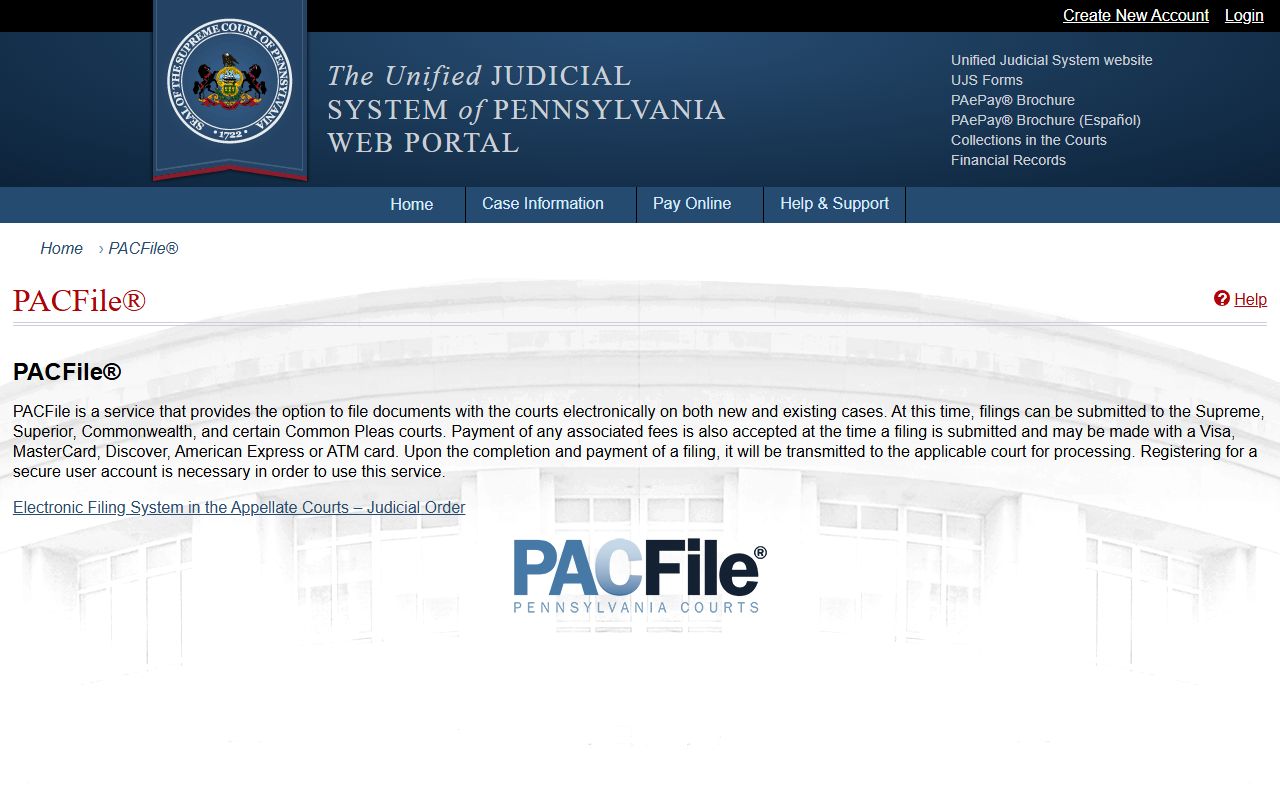
PACFile, shown above, allows electronic submission of documents to Pennsylvania appellate courts and sends notices of court action to registered users.
The PAePay system lets you pay court fines, costs, traffic tickets, and restitution online. It covers Common Pleas and Magisterial District Courts that have opted into the program. Accepted payment methods include Visa, MasterCard, Discover, American Express, and ATM cards. A non-refundable service fee of 2.75% applies to each transaction. The maximum payment per transaction is $2,500. PAePay also handles bail payments remotely for cases at both the MDJ and Common Pleas levels. Confirmation numbers are issued for every payment and should be saved.
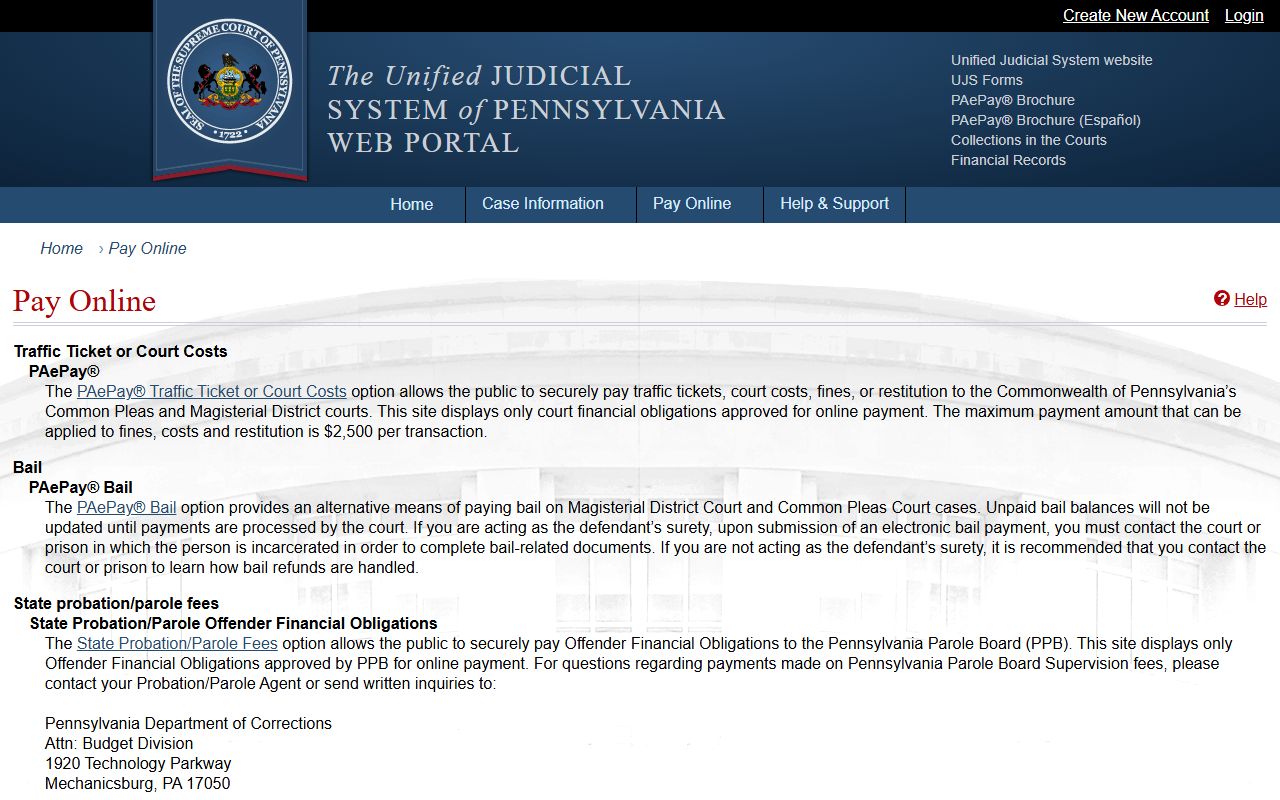
PAePay allows online payment of court costs and fines without visiting the courthouse, supporting Pennsylvania courts across all participating jurisdictions.
Pennsylvania Right-to-Know Law and Court Records
Pennsylvania court records are generally open to the public. The Pennsylvania Right-to-Know Law, 65 P.S. § 67.101, gives the public the right to access government records. Court dockets and case files fall within this framework. You do not need to be a party to the case to view most records. Any member of the public can search dockets through the UJS Portal or request copies from the Prothonotary.
Some records are restricted from public view. Under 204 Pa. Code § 213.81, certain information must be redacted from public filings. Social Security numbers, financial account numbers, and personal information about minor children are kept out of public documents. A judge can also seal specific documents or an entire case file if a party shows good cause. Sealed records do not appear in docket searches. Juvenile delinquency records and certain dependency cases are confidential by default under state law.
If a public agency denies your request for records, you can appeal to the PA Office of Open Records. This office handles appeals under the Right-to-Know Law. Its mailing address is 555 Walnut Street, Suite 605, Harrisburg, PA 17101. Appeals can also be filed through an online portal at openrecords.pa.gov. Deadlines are strict. You must file an appeal within 15 business days of the agency's final denial. The office also offers mediation services for disputes that can be resolved without a formal hearing.
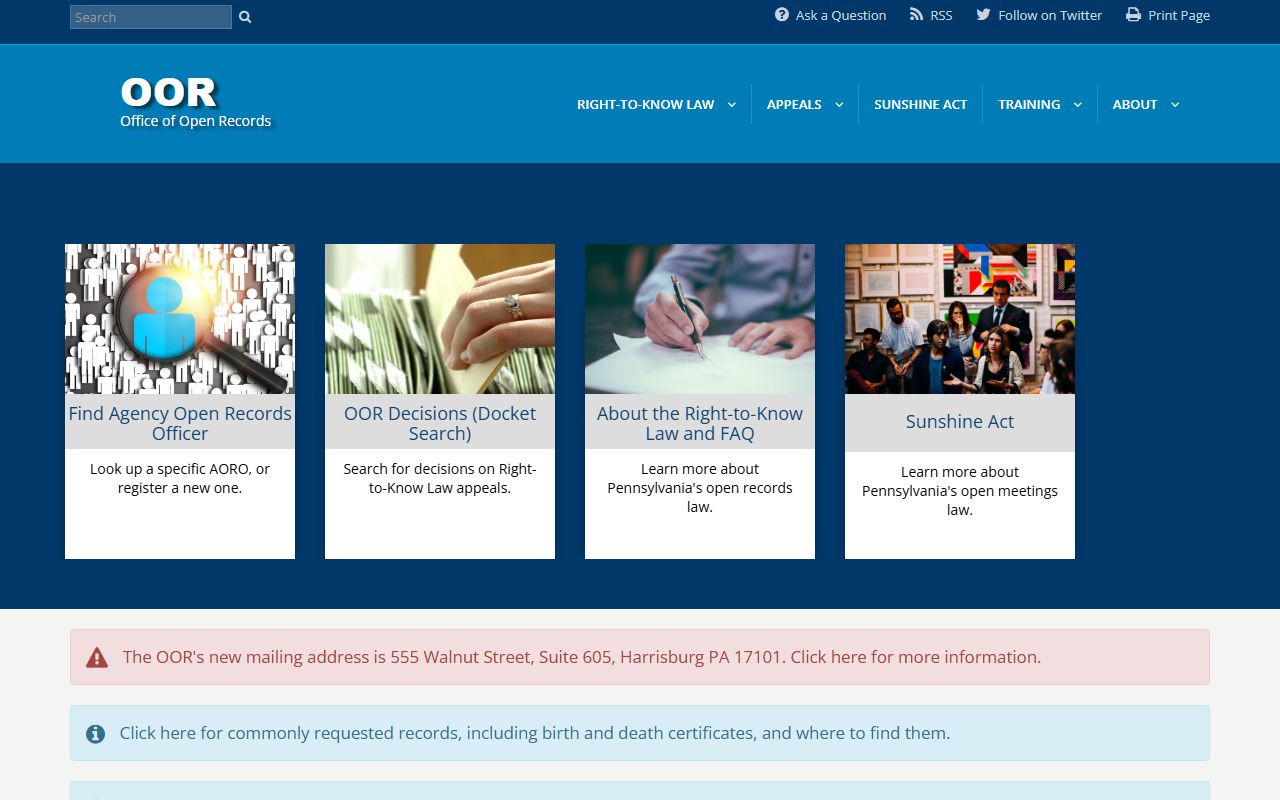
The PA Office of Open Records, shown above, handles appeals when public access to Pennsylvania government records is denied.
Note: Court records held by the judiciary operate under court-specific access policies distinct from the general Right-to-Know Law that applies to executive branch agencies in Pennsylvania.
How to Get Copies of Pennsylvania Court Records
Getting copies of Pennsylvania court records depends on what you need and which court handled the case. For docket information, the UJS Portal provides free access with no registration. For actual case documents, you must contact the court where the case was filed. The Prothonotary handles civil records at the Court of Common Pleas. The Criminal Division clerk handles criminal case files. Each county office sets its own process and copy fees.
In-person requests are the most reliable method. Visit the courthouse in the county where the case was filed and ask at the Prothonotary or Clerk of Courts window. Staff can search by name or case number and pull the file. You can review documents and request copies on the spot. Most offices accept cash and some take credit cards. Call ahead to confirm hours and accepted payment methods before visiting.
Many county courts accept mail requests for copies. Send a written request with the full names of the parties, the case number if known, a description of the documents you need, and payment for the estimated copy fee. Include a self-addressed envelope. Response times vary by court workload. For appellate court records, contact the Prothonotary of the appropriate court. Filing offices for the Superior Court are in Philadelphia, Harrisburg, and Pittsburgh. The Commonwealth Court Prothonotary is based in Harrisburg.
Official UJS forms and documents are available at no charge on the Pennsylvania courts website. You can download complaint forms, public records request forms, and forms for self-represented parties in civil and family cases. Forms are provided in PDF format. Bilingual forms in English and Spanish are available for many common proceedings. Individual county courts may also post local forms on their own websites.
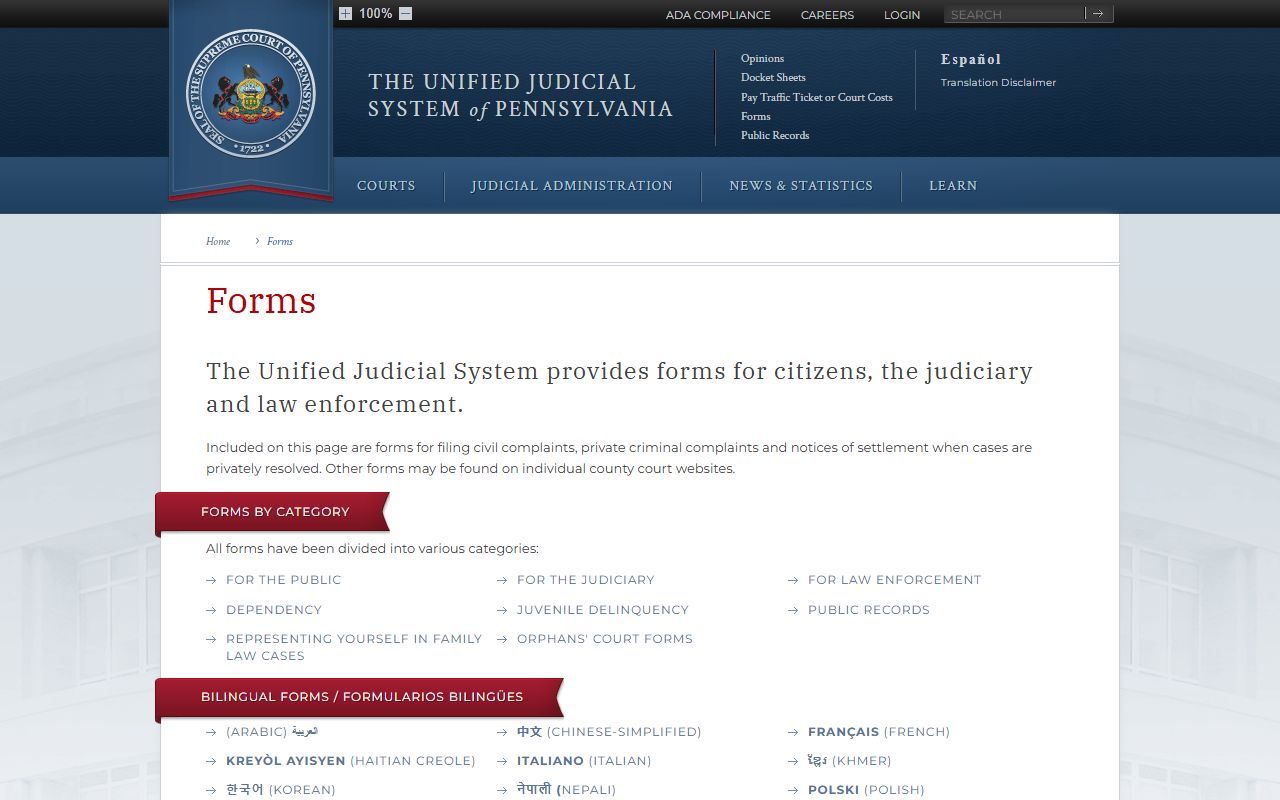
The UJS forms portal shown above offers downloadable court forms for civil, criminal, and family cases across Pennsylvania courts.
Browse Pennsylvania Court Records by County
Each of Pennsylvania's 67 counties has its own Court of Common Pleas and Magisterial District Courts. Select a county below to find local court contact information and resources for Pennsylvania court records in that area.
Court Records in Major Pennsylvania Cities
Residents of major cities file cases at their county courthouse. Select a city below to learn about Pennsylvania court records in that area.